Monday, 5 October, 2026
Two people can have the same cut, stitched the same way, and end up with completely different scars. One fades to a pale line. The other thickens, reddens, itches, and keeps going.
If you are in the second group, the first thing worth establishing is which kind of raised scar you actually have because hypertrophic scars and keloids look similar in the early weeks and behave very differently afterwards.
The distinction is simpler than most people expect.
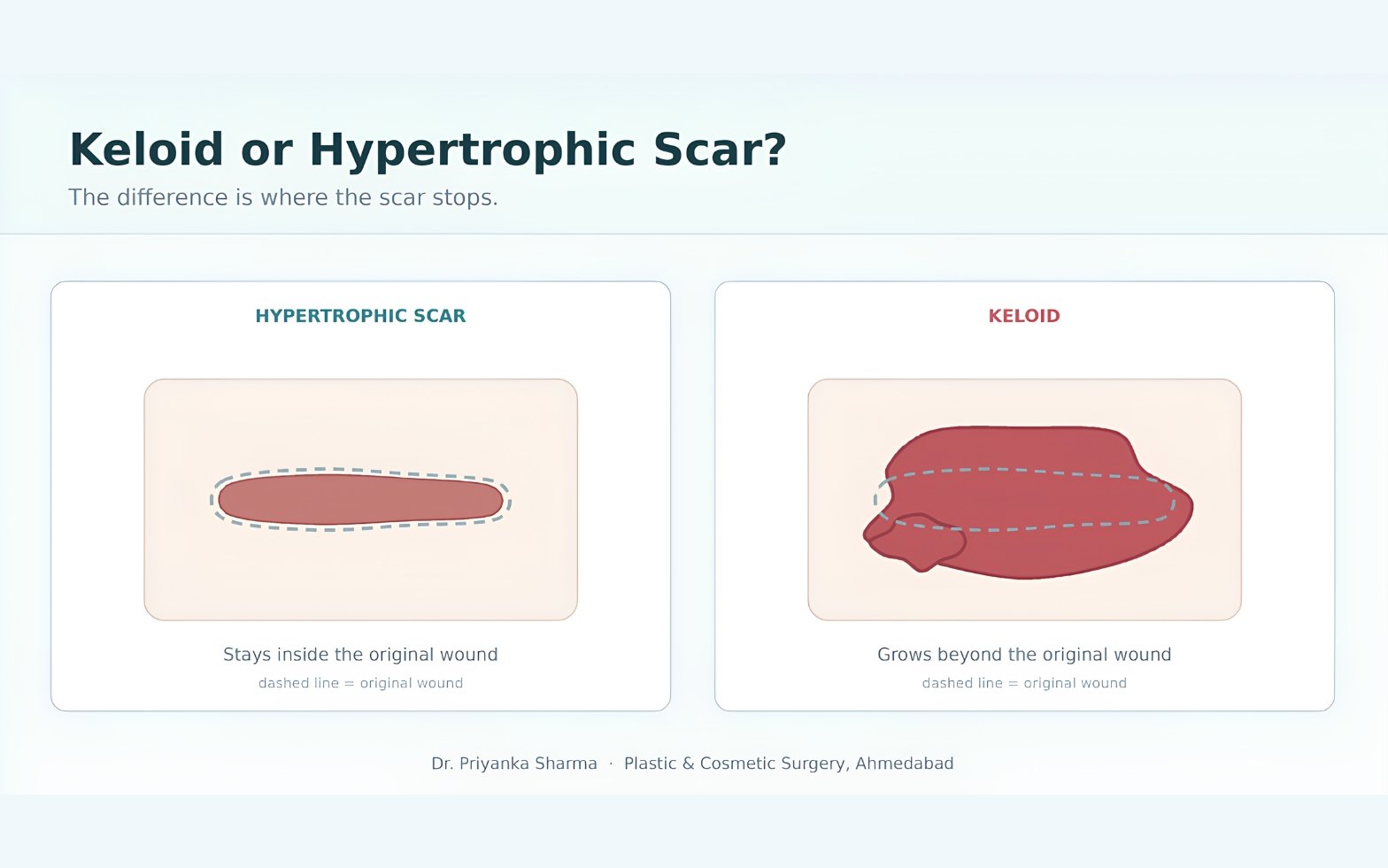
A hypertrophic scar stays inside the boundary of the original wound. It may be thick, red and raised, but it does not spread into skin that was never injured.
A keloid grows past the edge of the original wound and into normal surrounding skin. It behaves less like a scar and more like a benign overgrowth, which is why a small ear piercing can eventually produce a lump many times its size.
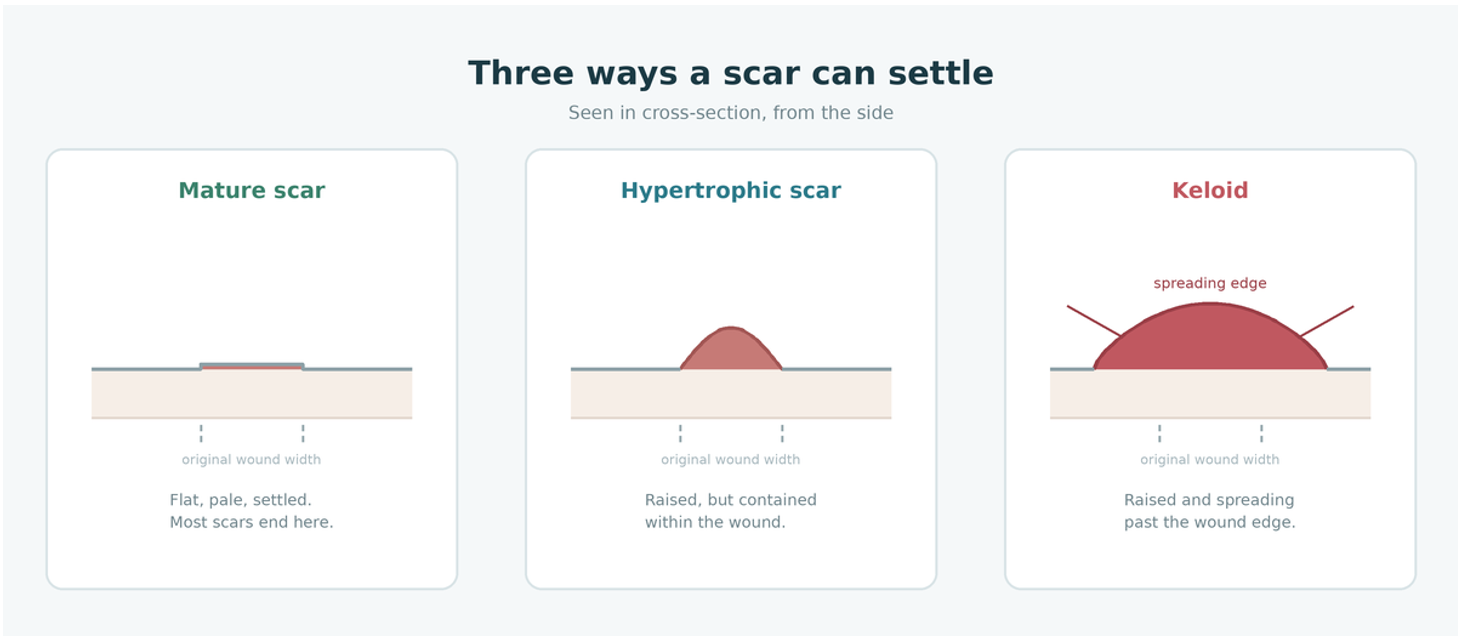
One honest caveat, and it comes from the surgeons who wrote the international consensus on scar classification: plenty of scars sit in between. Some lesions show intermediate features that make it genuinely difficult to say which they are. If your doctor hedges on the label, that is not evasion it can be an accurate description of what is in front of them.
This is where the two diverge, and it matters more than the label.
Hypertrophic scars usually appear within weeks of the injury or operation. They tend to grow for three to six months, sit static for a while, and then begin to settle. Full maturation can take up to two years. Many improve substantially without anything being done to them.
Keloids can appear months, sometimes years, after the injury — occasionally after an injury nobody remembers. And they do not regress. The NHS puts it bluntly: you cannot get rid of a keloid scar, and left alone it will not go away on its own.
That difference explains a lot of frustration. A raised red scar at three months may simply be a scar that has not finished settling. A raised scar at three years that is still creeping outwards is a different problem entirely.
Underneath, the difference is one of degree. Hypertrophic scars produce roughly three times the normal amount of collagen. Keloids produce around twenty times. The inflammatory phase of healing, which should switch off, does not and the tissue keeps building.
Skin colour and ancestry. Keloids are clearly more common in people with deeply pigmented skin. Published incidence ranges enormously between populations — from well under 1% in some to figures in the region of 6–16% in African, Caribbean and Hispanic populations. The NHS lists South Asian origin among the risk factors alongside African, African Caribbean and Chinese.
One finding is worth knowing, because it corrects a common assumption. A Kenyan study compared keloid prevalence in people with normally pigmented skin against people with albinism — 8.5% versus 7.8%, with no statistically significant difference. Melanin itself does not appear to be the cause. The risk seems to track ancestry and genetics rather than skin tone as such.
There is no reliable population-level figure for keloid prevalence in India. Anyone quoting you a precise Indian percentage is quoting something that has not been measured.
Family history. Around a third of people who develop keloids have a first-degree relative who also gets them.
Age. Onset peaks between roughly 10 and 30, with a spike just after puberty.
Where the wound is. This is the most practical risk factor of all.
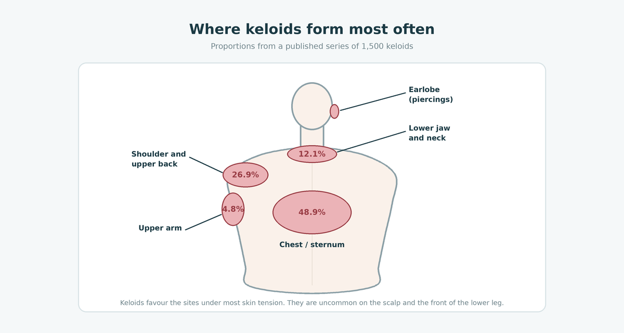
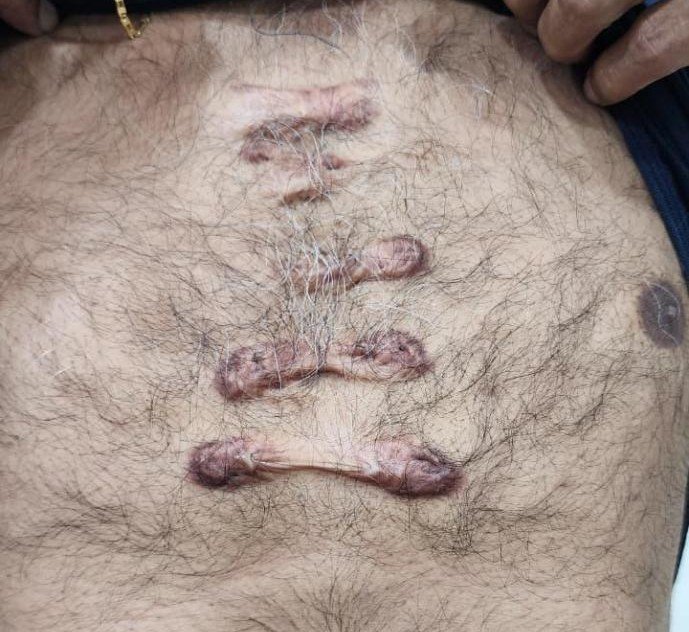
In a published series of 1,500 keloids, almost half were on the front of the chest, a quarter on the shoulder and upper back, and around one in eight on the lower jaw and neck. Earlobes are a classic site because of piercings.
The pattern is not random. These are the areas under the most repeated skin tension — the chest with every breath, the shoulders with every arm movement, the earlobe tugged by a heavy earring. Keloids are uncommon on the scalp and the front of the lower leg, where that constant pull is absent.
How long the wound took to heal. In a study of 383 children with burns, hypertrophic scarring occurred in 8.1% of those who healed within 21 days — and 56.0% of those who took longer. The risk rose measurably with every additional day. Anything that delays healing, particularly infection, pushes a scar towards thickening.
Other triggers. Surgery, burns, acne, chickenpox, insect bites, tattoos, injections and vaccination sites can all set one off. So can a wound closed under tension.
Be prepared for this to take time and more than one approach. Keloids in particular are managed rather than cured.
Silicone gel or sheeting is first-line in virtually every clinical guideline, is cheap, and is close to risk-free. It is worth knowing that two Cochrane reviews have both concluded the underlying trial evidence is weak and at high risk of bias. Guideline consensus and trial quality are not the same thing. Used properly — applied once the wound has fully closed over, for at least 12 hours a day and ideally longer, for months rather than weeks — it remains the sensible starting point.
Steroid injections into the scar are the best-established active treatment. Reported response rates range from 50% to 100%. Recurrence is the problem: roughly a third within a year and about half by five years in one review.
Side effects deserve a proper mention rather than a footnote, because they matter more on brown skin. Thinning of the skin, visible fine vessels and loss of pigment at the injection site are all recognised, and one review reported side effects in up to 63% of patients. A pale patch where a steroid was injected is far more conspicuous on Indian skin than on fair skin, and it can take many months to recover.
Other injections. 5-fluorouracil, usually combined with steroid, has reasonable evidence — a systematic review of over 2,000 patients found around two-thirds improved by more than half, with relapse in about 16%. Hyperpigmentation is a recognised side effect and, again, more visible on darker skin. Bleomycin and verapamil have been used; the evidence for both is thinner, and verapamil appears less effective than steroid.
Cryotherapy works, particularly over several sessions. The caution for Indian patients is specific: freezing damages pigment cells, and the resulting pale patches are more prominent and more likely in darker skin.
Lasers improve redness, texture and pliability — reported improvements of 57% to 83% in hypertrophic scars after one or two pulsed-dye laser treatments. No laser cures a keloid on its own. In Fitzpatrick skin types IV to VI, which covers most Indian patients, there is a real risk of temporary darkening afterwards, and pre-treatment with a lightening agent is often recommended.
Pressure therapy — including pressure earrings after ear keloids — is well established for burns and for the earlobe, though it depends entirely on wearing it consistently for months.
Surgery, but never on its own. This is the single most important thing to understand about keloid treatment. Published recurrence after cutting out a keloid with no follow-up treatment ranges from about 45% to close to 100%, depending on the series and the site. India’s own dermatology guidelines state it plainly: after excision of a keloid, an adjuvant should always be used. Pre-sternal keloids almost invariably come back if excised alone. Earlobe keloids are the recognised exception, recurring considerably less often.
Combine surgery with an adjuvant and the picture changes. Published recurrence rates fall to roughly 14–29% with radiotherapy, 3–15% with brachytherapy, and 7–33% with steroid injections. Radiotherapy after excision is effective; its long-term safety has never been properly quantified, with only scattered case reports of later malignancy, so most centres avoid it in children and shield nearby tissue. That is the honest position — not “safe”, and not “causes cancer”.
Vitamin E. A systematic review of the published trials found insufficient evidence that topical vitamin E alone meaningfully improves scars — and one study reported contact dermatitis in up to a third of patients using it.
Onion extract preparations. Widely sold, and the data remains inconsistent and of poor quality. One Cochrane comparison found silicone performed slightly better.
Neither will harm you. Both are frequently bought instead of treatment that would have worked.
Tell the surgeon before the operation, not afterwards. A known keloid former having a planned procedure — particularly on the chest, shoulder or earlobe — should have a prevention plan agreed in advance: closure that minimises tension, silicone started as soon as the wound has sealed, planned steroid injections for high-risk wounds, and in selected cases planned radiotherapy.
It is also worth knowing that keloids often do not recur for six months to two years. A scar that looks fine at three months is not yet proof of anything.
Most raised scars are exactly what they look like. A few are not, and these features warrant prompt assessment rather than another round of treatment:
Two conditions in particular can imitate a keloid. Dermatofibrosarcoma protuberans is a rare skin tumour that genuinely looks like one, and has been treated as a keloid before the diagnosis was made. And a long-standing burn or chronic wound scar can, decades later, develop a skin cancer within it — the average interval in published series is around 29 years. Both are uncommon. Both are reasons why a scar that behaves oddly should be examined rather than injected again.
Keloids are not only a cosmetic problem. In a study of 106 patients with keloids and no other skin disease, pain and itch were the strongest predictors of reduced quality of life, and the condition was associated with considerable impairment of emotional wellbeing.
If a scar itches constantly, catches on clothing, hurts, or stops you wearing what you want to wear, that is a medical reason to treat it, not a vanity one.
Will my keloid go away on its own? No. Keloids do not regress spontaneously. Hypertrophic scars often do improve on their own over one to two years, which is one reason the distinction matters.
Can I just have it cut out? Not on its own. Excision alone carries a published recurrence rate of roughly 45% to nearly 100%. Surgery is used as part of a plan that includes an adjuvant treatment, most often steroid injections or radiotherapy.
Does keloid mean I am more likely to get skin cancer? No. A keloid is a benign overgrowth of scar tissue. Separately, a rare skin cancer can develop in a long-standing burn or chronic wound scar, and a rare tumour can be mistaken for a keloid — which is why a scar that changes or behaves unusually should be examined.
Will steroid injections lighten my skin? They can. Loss of pigment at the injection site is a recognised side effect and is more noticeable on brown skin. It often recovers, but it can take many months. This is worth discussing before the first injection rather than after it.
I got a keloid after ear piercing. Can I still wear earrings? Possibly, after treatment, but the site will remain higher risk. If thickening starts at a new piercing, removing the earring early and switching to a pressure earring worn most of the day for several months is the standard advice.
Are keloids more common in Indian skin? Keloids are clearly more common in people with deeply pigmented skin, and South Asian origin is listed among the risk factors. However, no reliable population-level prevalence figure exists for India — so treat any specific Indian percentage you read with caution.
How long before I know whether treatment has worked? Longer than most people expect. Keloids often do not recur for six months to two years after treatment, so follow-up needs to run well beyond the point at which the scar first looks settled.
A raised scar that is still growing, still itching, or has not changed in a year is worth having examined rather than treated by trial and error — partly to confirm what it is, and partly because the treatment plan depends on the answer.
Dr. Priyanka Sharma assesses and treats keloids and hypertrophic scars in Ahmedabad, including scars from surgery, burns and trauma. You can read more about reconstructive procedures or about the treatments used to improve scars.