

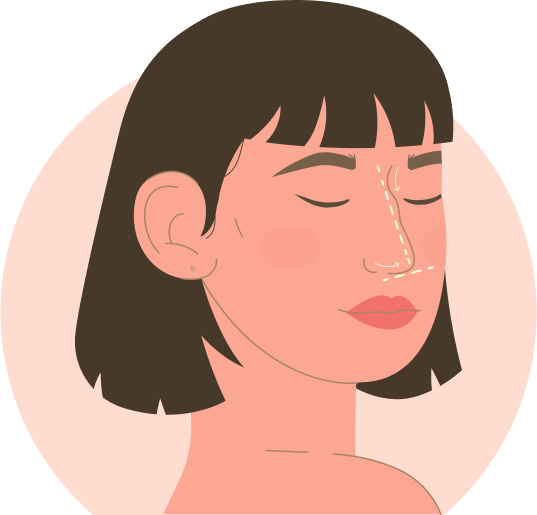
Rhinoplasty is a surgical procedure used to change the shape or structure of the nose. Depending on the patient's concerns and clinical findings, it may address features such as the nasal bridge, tip, width, or overall proportions. In selected cases, surgery may also help address structural problems that affect nasal breathing.
At Kaayantar, Dr. Priyanka Sharma provides consultations for patients considering rhinoplasty. The assessment involves understanding the patient's concerns, examining the nasal structure, reviewing medical history, and discussing what surgery may realistically achieve. The nose plays an important role in both facial appearance and breathing, so planning considers both external shape and internal structure.


Explore your options for reshaping your nose to suit your facial features.
Rhinoplasty reshapes the nose for aesthetic harmony or to correct breathing impairments. Dr. Priyanka Sharma combines structural precision with artistic facial balance to achieve natural, enduring outcomes.

Analyzing facial proportions to design a nasal shape that complements your unique features.

Simultaneously addressing structural breathing difficulties and cosmetic contour goals.

Expert handling of cartilage and bone structures via open or closed rhinoplasty approaches.

Open dialogue detailing achievable changes, healing timelines, and structural limitations.

Careful follow-up during cast removal, swelling resolution, and tissue stabilization.

Get a consultation to understand your options and find the right treatment for your needs.

Rhinoplasty popularly known as “nose job” is an aesthetic surgery by which the external appearance of the nose is changed to enhance features. In certain cases, if there are underlying breathing issues a septal surgery can be combined to improve functionality as well.


Get expert guidance on rhinoplasty and find the right treatment for your needs.
The surgical plan depends on intended changes, nasal anatomy, and whether functional correction is required. Main stages include:
Review of medical history, previous injuries/operations, medicines, breathing symptoms, and treatment goals with a physical examination.
Discussion of proposed changes, approach, anaesthesia, limitations, and potential risks, utilizing photographs when clinically appropriate.
Commonly performed under general anaesthesia, tailored to the procedure and clinical circumstances.
Modification of bone, cartilage, or supporting tissues through selected incisions, including cartilage grafts if needed.
Incisions are closed, and a nasal splint or support is applied when indicated, followed by initial recovery monitoring.



Rhinoplasty is performed by closed approach wherein incisions are completely hidden inside the nostrils or by open approach wherein a < 1cm incision is used at base of tip of nose. In either method, the mark fades away and gives you a virtually scarless final result.
 Chat With Expert
