Saturday, 26 September, 2026
Most people arrive at a scar revision consultation hoping the scar can be removed. It cannot. The American Society of Plastic Surgeons states it plainly: a scar cannot be completely erased.
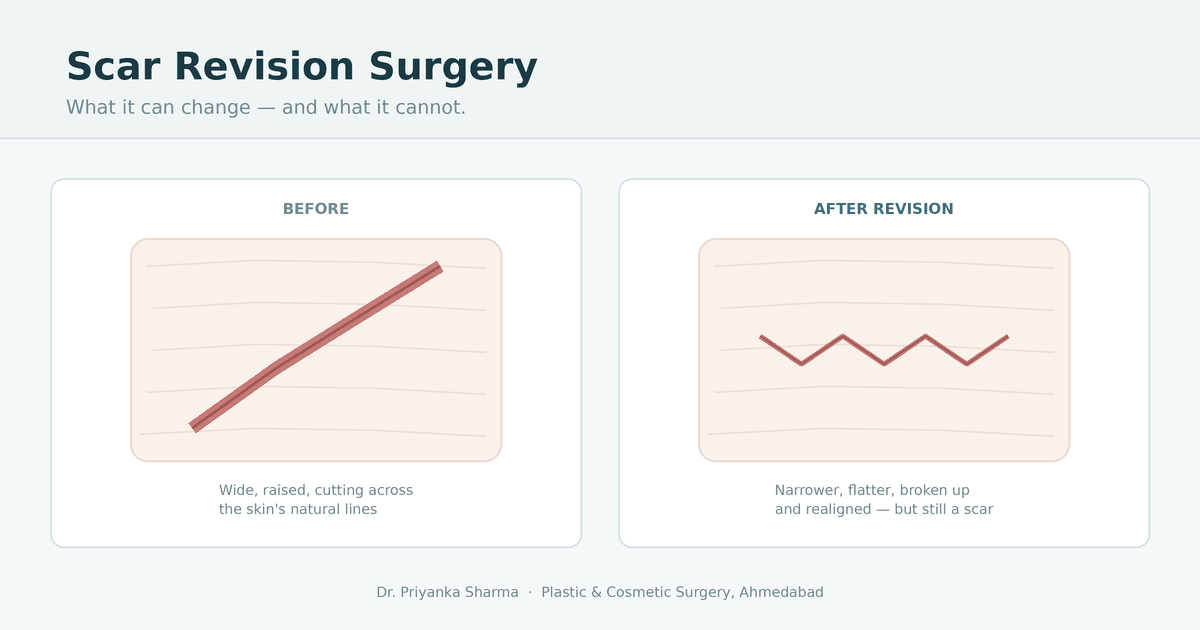
What surgery can do is replace a scar that draws the eye with one that doesn’t — narrower, flatter, turned into a direction the skin tolerates better, or broken up so the eye stops following it. That is a real and often substantial improvement. It is not the same as removal, and the difference between those two expectations is usually the difference between a satisfied patient and a disappointed one.
This is the most common mistake, and it is an understandable one — a new scar looks its worst early, which is exactly when people want it fixed.
Scars take roughly 12 to 18 months to mature. An immature scar is red or pink, often firm, sometimes itchy. A mature one is flat and pale. Operating on a scar that has not finished settling tends to produce a poor result, because you are trading a scar that was still going to improve for a fresh wound that must go through the entire process again.
Some sources give shorter intervals, and the judgement is partly clinical — surgeons often watch for a plateau, where a scar has stopped changing over two or three months of observation. But the principle holds: a red, raised scar at three months is frequently a normal scar in progress, not a surgical problem.
There are exceptions where waiting is wrong. A contracture that is limiting joint movement, tightening around the neck, pulling an eyelid away from the eye, or restricting mouth opening is treated on its own timetable, because function and — in the case of the eye — sight are at stake.
And waiting applies to surgery, not to scar care. A young scar should still be treated: silicone once the wound has closed, sun protection, and in some cases steroid injections within the first weeks. Doing nothing for eighteen months is not the advice.
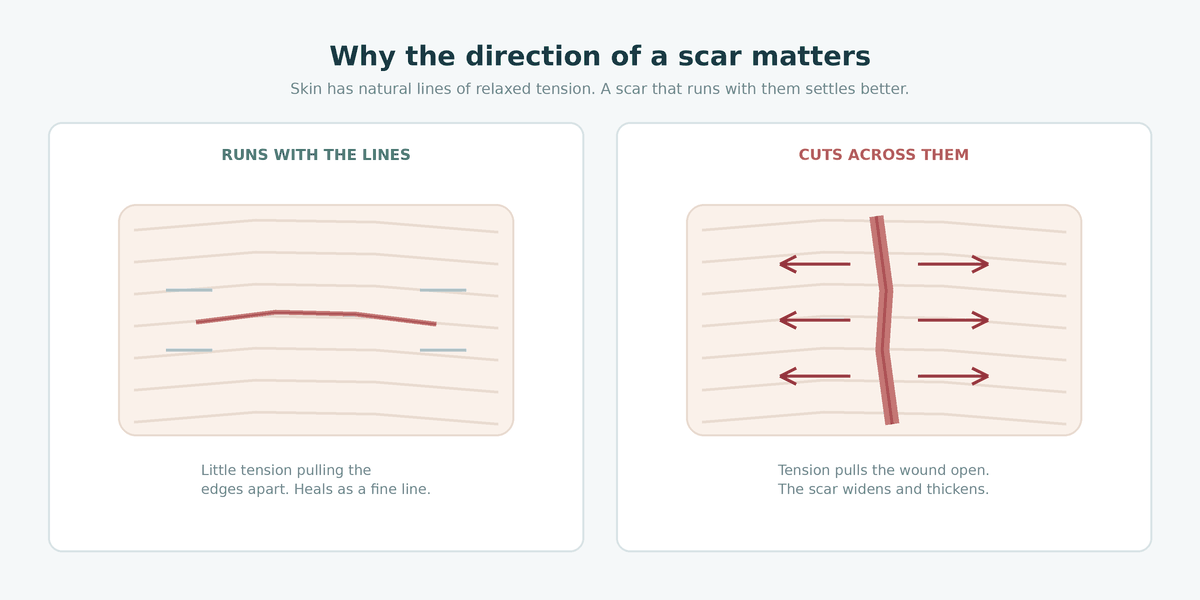
Skin has natural lines of relaxed tension — the creases that appear when you relax a part of the body and gently pinch the skin. A wound that runs along those lines closes with very little pull on its edges and usually heals as a fine line. A wound that cuts across them is under constant tension, and tension is what makes scars widen and thicken.
That is why direction is one of the clearest predictors of whether revision will help. A scar sitting more than about 30 degrees away from those tension lines is a good candidate for reorientation.
Beyond direction, revision is generally worth considering for:
Revision is not useful where the new scar would be worse than the old one, or where it would limit function. That is stated as a formal contraindication, and it is the judgement your surgeon is making when they advise against operating.
Excision and layered closure. The scar is cut out and the wound closed carefully in layers, with deep sutures taking the tension off the skin. For a narrow, well-oriented scar that simply healed badly, this may be all that is needed.
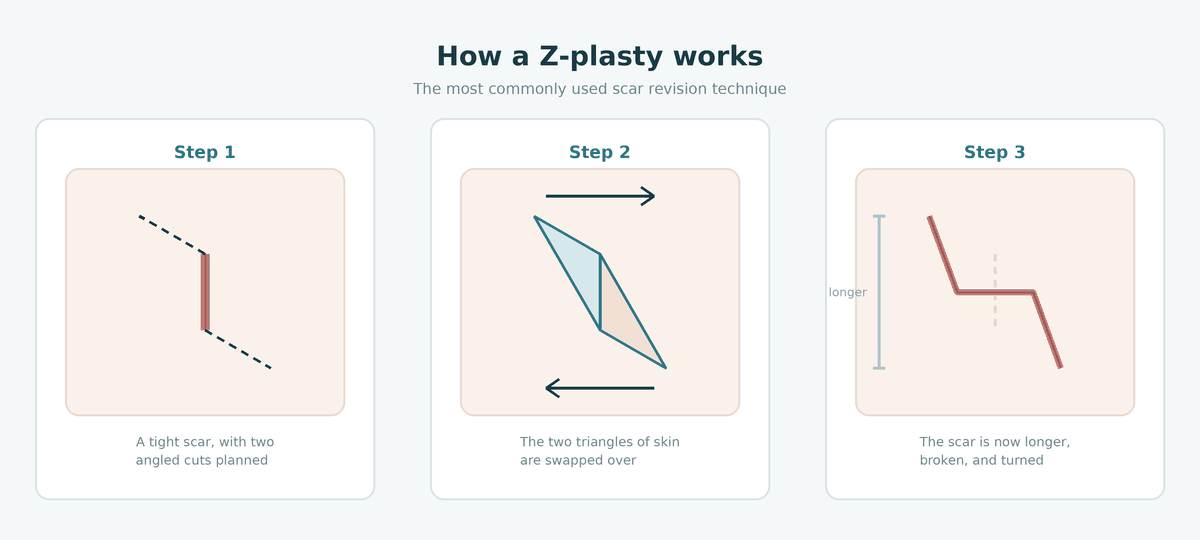
Z-plasty. The most commonly used scar revision technique. Two triangular flaps of skin either side of the scar are cut and swapped over. The effect is to lengthen the scar, break it up, and rotate its direction — a classic Z-plasty with 60-degree limbs turns the scar through 90 degrees and lengthens it by around 75% in theory. In practice living skin does not behave quite as the geometry predicts, and the real gain depends on how pliable the tissue is. It is the technique of choice for a tight, contracted scar or one running the wrong way.
W-plasty and broken-line closure. Instead of one continuous line, the scar is replaced with a fine zigzag. The eye follows a straight line easily and an irregular one poorly, so an interrupted scar of the same total length reads as less obvious.
Grafts and flaps. Where a contracture is released, the gap left behind often cannot simply be stitched closed. Skin is brought in — either as a graft or, where deeper tissue is exposed, as a flap with its own blood supply. Flaps contract less afterwards, which matters when the whole point was to release a contracture.
Fat grafting. Useful for scars that are depressed, hard, or stuck down to the tissue beneath. A systematic review covering more than 3,000 patients reported patient satisfaction of around 89%, with the biggest gains in scar stiffness and pliability, and an average of 1.4 sessions. Minor complications occurred in under 5%.
Subcision releases the tethering bands under a depressed scar so it can lift. It works best for soft, rolling scars, and usually needs more than one session.
Resurfacing — dermabrasion or laser — smooths the surface rather than changing the structure, and is often used as a second stage some weeks after the surgery itself.
Most revisions combine two or three of these, alongside silicone, steroid injections or pressure afterwards.
The best available evidence is a 2026 meta-analysis of 30 studies covering more than 5,000 patients. Pooled patient satisfaction after scar revision was 78.6%. Satisfaction was higher for scars from trauma (88.3%) than for burn scars (74.5%). Minor complications occurred in 8.6% of patients, with no major complications reported.
Roughly four in five patients are satisfied. Which also means about one in five are not — and that is the honest number to hold in mind. The ASPS notes that a single operation does not always achieve the optimal result, and further surgery is sometimes needed.
Cutting out a keloid without a plan to prevent its return is the one clearly wrong move in this entire subject.
Published recurrence after excision alone ranges from about 45% to nearly 100%. India’s own dermatology guidelines state that after excision of a keloid an adjuvant should always be used, and that pre-sternal keloids almost invariably recur if excised alone. Earlobe keloids are the recognised exception, recurring far less often.
With an adjuvant — radiotherapy, steroid injections, 5-fluorouracil or pressure — recurrence drops substantially, to around 20% in pooled figures for post-excision radiotherapy.
A keloid tendency is also a specific contraindication to Z-plasty, because the technique creates more scar, not less. If you or a close relative form keloids, say so at the consultation.
Bleeding and bruising, infection, poor healing or wound separation, altered sensation or numbness, persistent pain, and asymmetry. Specific to scar revision: the new scar may recur, thicken, or in some cases end up worse than the original. Skin pigmentation can change. A raised, puckered “trapdoor” appearance can develop where a flap has been raised. Further surgery is sometimes needed.
Factors that impair healing — diabetes, immunosuppression, poor nutrition and smoking — matter here. Smoking in particular: a meta-analysis found roughly three and a half times the odds of tissue or flap necrosis in smokers, and around twice the odds of delayed healing and wound separation. Stopping at least four weeks before surgery is the usual recommendation.
The first phase — swelling, discolouration, discomfort — generally takes one to two weeks. Stitches usually come out at around a week. The new scar will be red for several weeks afterwards, which is normal and not a sign that something has gone wrong.
Final results take months. In some cases it takes a year for the new scar to settle and fade fully. This is the single hardest part of scar revision for patients, because there is a long period during which the new scar does not yet look better than the old one.
Most Indian patients fall into Fitzpatrick skin types IV to VI, and the risk of pigment change after a procedure — darkening or lightening — is higher in these skin types. Darkening after inflammation is one of the commonest reasons patients with brown skin consult a dermatologist at all.
This does not rule anything out. It changes how it is done. Where lasers are used, longer wavelengths, lower energy settings and cooling of the skin surface reduce the risk, and treatment with a lightening agent before and after resurfacing has been shown to reduce post-inflammatory darkening.
Sun protection is not optional. Guidance ranges from keeping a scar covered and using SPF 30 or above for at least a year, to a high-factor sunscreen until the scar has fully matured. In Indian sun, take the stricter version.
Sometimes, and it depends entirely on why the scar is there.
Under IRDAI’s standardised health insurance exclusions, cosmetic and plastic surgery is excluded “unless for reconstruction following an Accident, Burn(s) or Cancer or as part of medically necessary treatment to remove a direct and immediate health risk to the insured” — with medical necessity certified by the treating doctor.
In practice that means two routes. A scar from a road accident, a burn or cancer surgery falls within the carve-out by its cause. A scar causing a genuine functional problem — a contracture limiting a joint, an eyelid pulled out of position — may qualify under the medical-necessity limb, but requires certification in writing.
Revision of an old acne scar or an elective surgical scar with no functional consequence sits squarely inside the exclusion.
That wording tells you when the exclusion does not apply. It does not by itself guarantee a claim will be paid — policy wordings, waiting periods and sub-limits still apply. Raise it at the consultation and ask for the certification and pre-authorisation in writing rather than assuming.
How long should I wait before having a scar revised? Generally 12 to 18 months, until the scar has matured. Exceptions are made for contractures limiting movement, or scars pulling on the eyelid, mouth or neck, where waiting causes harm.
Will the scar be gone afterwards? No. Scar revision replaces one scar with another intended to be less noticeable. A scar cannot be completely erased.
How likely am I to be happy with the result? Pooled patient satisfaction across published studies is around 78.6% — higher for scars from trauma, lower for burn scars. About one in five patients is not satisfied.
Can a keloid be cut out? Not on its own. Recurrence after excision alone runs from roughly 45% to nearly 100%. Excision is combined with an adjuvant such as radiotherapy or steroid injections, which brings recurrence down substantially.
Will the new scar go dark? Pigment change is more likely in Fitzpatrick skin types IV to VI, which covers most Indian patients. It is usually temporary and it is manageable — with careful technique, sun protection and, where appropriate, treatment before and after the procedure.
How long is the recovery? One to two weeks for the initial healing, with stitches out at around a week. The new scar stays red for several weeks and takes months — sometimes a year — to reach its final appearance.
Will one operation be enough? Often, but not always. The ASPS notes that optimal results are not always achievable in a single procedure. Resurfacing or a further adjustment is sometimes planned as a second stage.
Does insurance cover scar revision in India? It can, where the scar follows an accident, a burn or cancer treatment, or where there is a certified functional problem. Purely cosmetic revision is excluded. Check your policy wording and ask for certification in writing.
Not every scar improves with surgery, and a consultation that tells you so is more valuable than one that books you in. The useful questions are whether the scar has finished maturing, which direction it runs relative to your skin’s tension lines, and whether you have any tendency to form keloids.
Dr. Priyanka Sharma assesses scars from surgery, trauma and burns in Ahmedabad. You can read more about reconstructive procedures, or about the treatments used to improve scars before deciding whether surgery is the right route at all.